
What It Is and Why It’s Important
Let’s start with a common misunderstanding…
Many golfers believe their handicap reflects their average score. It doesn’t.
Your handicap is actually a measure of your potential, your best golf — what you’re capable of when you play well.
Remember:
- Your handicap index is calculated from your best 8 of your last 20 rounds
- It is designed to represent your better golf, not your typical golf
In reality:
- Single-figure golfers tend to score 4–5 shots above their handicap
- Higher-handicap golfers tend to score 5–6 shots above their handicap
So, if you’re playing off 8, your normal score is likely closer to 85, not 80.
And that’s exactly where Personal Par comes in.
Why Personal Par Matters
Chasing scorecard “pars” sounds great… but for most golfers, it creates problems.
It can lead to:
- Fast and Poor decision making
- Trying too hard and forcing shots
- Adding Unnecessary pressure
Yes — you can make par on any hole.
But that doesn’t mean you should expect to every time.
Personal Par gives permission to shift the focus.
Instead of chasing perfection, you’re working with a realistic, performance-based benchmark that helps you:
- Make better smarter decisions for consistently keeping scores low
- Play with more freedom
- Understand what’s unacceptable, acceptable and exceptional for your game
And This Is a Big One…
Personal Par is NOT about lowering your expectations.
It’s about being honest with them.
Every time I introduce this idea, I hear the same thing:
“That sounds too easy… I want to be better than that!” with a hint of insult
My response is always the same:
“Don’t tell me it’s easy — show me it’s easy.”
I absolutely want you to score under par and beat your Personal Par.
That’s the goal.
But you only earn the right to lower your targets by consistently outperforming them.
- If you regularly score below your Personal Par → your handicap will come down
- If you score above it more often than below it → that’s your current level
It’s simple maths — but it’s something many golfers either haven’t considered, don’t understand or choose not to use to their advantage.
What Is Personal Par?
Your Personal Par is your realistic scoring benchmark based on how you actually perform — not your best-case scenario.
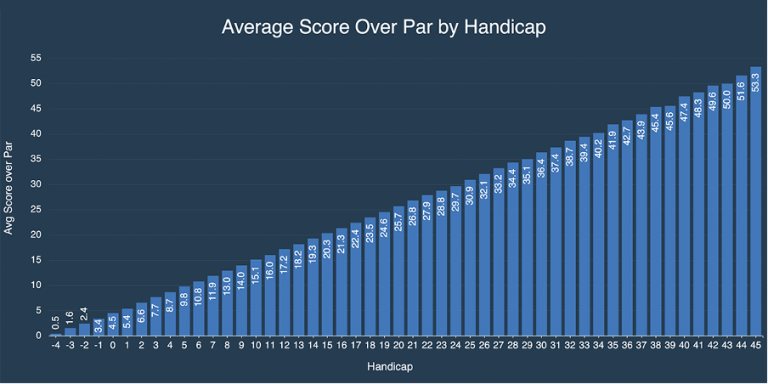
Using average scoring data (like from Arccos), you can map your handicap to a more realistic expected score.
For example:
- An 8-handicap → Personal Par ≈ 85
That becomes your new reference point.
How to Use Personal Par
- Find Your Number
Use the data (like the chart provided by Arccos) to identify your Personal Par.
This is your baseline — your “good, solid round.”
- Plan Your Round Strategically
Now it gets interesting…
If your Personal Par is 85, you’ve effectively got 13 shots over par to “spend.”
Instead of fighting that reality — use it.
- Turn difficult par 4s into “personal par 5s”
- Accept that some holes are survival holes
- Focus on positioning instead of perfection
This creates:
- Less pressure
- Better decision-making
- More birdie opportunities from smarter play
- Adjust for Conditions and Form
Personal Par isn’t fixed — it’s flexible.
- Playing in calm, firm conditions? → You might lower it slightly
- Cold, wet, windy day? → Add a shot or two
- Not feeling your best? → Give yourself some breathing room
Your target should reflect today’s reality, not just your handicap.
Rethinking a “Good Round”
This is where mindset really shifts.
If your Personal Par is 85:
- Shooting 30–31 Stableford points is actually a decent round
- It’s not poor — it’s acceptable
Start categorising your rounds:
- Exceptional → One of your best (your “top 8” level)
- Acceptable → Around Personal Par
- Unacceptable → Well below your standard
This gives you clarity, honesty, and perspective.
The Benefits
When you start measuring your performance against Personal Par – using stats like:
- Greens in Regulation
- Quality Greens (GIR inside 7 paces-20 feet)
- Putts per round
You begin to see your game more clearly.
You’ll:
- Make better decisions
- Manage your emotions better
- Play with more freedom
- Actually enjoy your golf more
Final Thought
Personal Par is a game-changer.
It’s not about lowering the bar —
it’s about setting the right one.
Set your Personal Par.
Beat it consistently.
Then move it.
That’s how you pursue excellence.
Play this way and you’ll start playing smarter, freer, and better golf…
Mark Day
PGA Teaching Professional


